One of the most counterintuitive patterns I encounter in advisory work: platforms that are growing in users, revenue, or both — but quietly losing organic search traffic. The growth masks the loss. By the time it becomes visible, the structural causes are months old.
An illustrative composite of the pattern, drawn from advisory work: a growth-stage SaaS platform sees total traffic grow 40% year-over-year while organic search as a share of acquisition drops from 44% to 27%. One caution before diagnosing: a falling organic share is not by itself proof of organic decline — absolute organic sessions, impressions, clicks, and ranking positions have to be checked separately, because share also falls when paid channels simply grow faster. In the pattern this article describes, those absolute signals confirm the erosion: crawl rates declining, indexation coverage dropping, positions shifting — while healthy-looking total-traffic dashboards keep anyone from looking.
What Is the Masking Effect in Organic Traffic?
What Is Organic Visibility?
The extent to which a website’s pages appear in unpaid search engine results for relevant queries. Organic visibility is shaped by factors including indexation coverage, ranking positions, and result presentation — and is influenced by technical factors such as crawlability, rendering architecture, site performance, and content structure, alongside content relevance and competition.
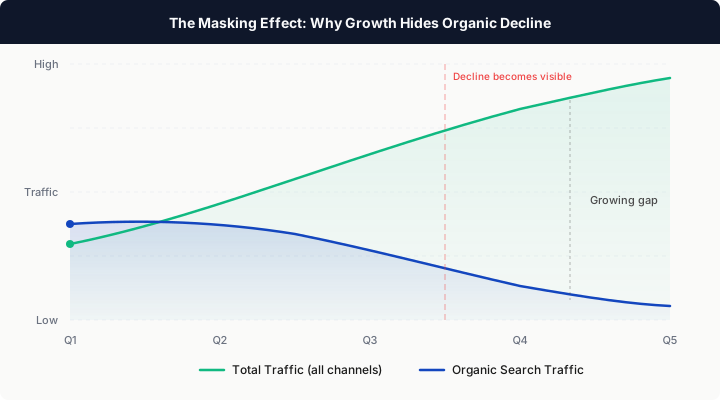
When a platform is growing through paid channels, direct traffic, or referrals, the organic traffic decline is easy to miss. Total traffic goes up. Revenue goes up. The dashboard looks healthy.
But organic as a percentage of total acquisition is declining. The keyword positions that drove early growth are eroding. New content isn’t indexing as quickly as it used to. And the compounding effect of organic visibility loss hasn’t hit yet — but it will.
This pattern is especially dangerous for platforms that depend on organic acquisition as their primary growth channel. The decline feels sudden when it eventually surfaces, but the causes were accumulating for months.
What Are the Technical Causes of Traffic Loss During Growth?
How Does Performance Degrade Under Load?
As traffic grows, infrastructure strain increases. The same pages that loaded in 1.5 seconds at low traffic start hitting 3-4 seconds during peak hours. Google’s mobile page speed research (2017) found that as page load time increases from 1 second to 3 seconds, the probability of bounce increases by 32% — and from 1 to 5 seconds, bounce probability increases by 90%. Two separate mechanisms connect this to search visibility — they are often conflated, but they operate independently:
- User-experience signals degrade — Google measures real-user performance, and as p75 metrics degrade, pages fail the Core Web Vitals thresholds defined for LCP, INP, and CLS. CWV contributes to page experience and Search success; it does not deterministically move rankings, but sustained field-data failure removes a positive signal.
- Server response time constrains crawling on large sites — this is a crawl-capacity mechanism, not a CWV mechanism. As Google’s Search Central documentation on crawl budget explains, “if responding to a request takes a long time, it affects Googlebot’s ability to crawl your site.” Slower server responses mean fewer pages crawled per session (an illustrative comparison: a platform answering in 100ms gives crawlers roughly 10x the page throughput of one answering in 1,000ms, all else equal), so new content is discovered later and changes take longer to reflect in search results.
How Does Feature Velocity Cause SEO Regressions?
Growing platforms ship features faster. Each new feature is tested for user functionality, but rarely for search impact:
- A new JavaScript-rendered widget whose content does not appear in the rendered HTML crawlers process
- Dynamic filtering that generates thousands of parameter-based URLs without canonical management
- A redesigned navigation that inadvertently changes the internal link structure
- Lazy-loaded content or links that never appear in a crawlable rendered state — the test is whether they show up in the rendered HTML, not where they sit on the screen
None of these appear as “bugs” in normal testing. They only manifest as gradual organic visibility changes weeks later. According to the HTTP Archive Web Almanac (2024), the median mobile page now loads approximately 500 KB of JavaScript — and each new feature adds to this weight. Google renders JavaScript, but under resource constraints and queuing — content that depends entirely on client-side execution can be indexed late or unreliably, and failures are hard to observe without explicit testing.
How Does Content Architecture Entropy Erode Visibility?
Early-stage platforms typically have clean content hierarchies. As the platform grows, the architecture accumulates complexity:
- Multiple teams publishing content without coordinated taxonomy
- Product pages, blog posts, and support docs competing for the same keywords
- Inconsistent URL structures from different development eras
- Redirect chains from URL changes that were never consolidated
This creates topical dilution — the site’s authority spreads across competing pages instead of concentrating on the most valuable targets. Ahrefs’ writing on keyword cannibalization describes how multiple pages targeting the same primary keyword can end up with both ranking lower than a single consolidated page would — though cannibalization is query- and page-specific, not automatic; it has to be confirmed per query in Search Console rather than assumed from overlapping titles.
The structural effect is real even before it is quantified: an internal link graph that should concentrate authority on the strongest page for each topic instead fragments it across multiple weaker candidates, and search engines have to choose between competing pages that each carry a partial signal.
Why Do Infrastructure Changes Cause SEO Problems?
Platform growth often triggers infrastructure changes: CDN migration, framework upgrade, hosting change, SSR implementation. Each of these can change how search engines interact with your site:
- CDN edge caching that serves different content to crawlers vs. users
- Framework changes that alter rendering behavior or page structure
- Hosting migrations that change server response characteristics
- HTTPS migrations or domain consolidations that disrupt link equity flow
How the Decline Typically Progresses
Organic erosion on a growing platform tends to follow a recognizable progression — the phases below are a practitioner pattern, not a fixed timetable; the durations vary widely by platform:
- Invisible degradation — Technical debt accumulates through normal development. Performance regresses incrementally, crawlability issues appear on low-traffic pages first, and no dashboard shows a problem because total traffic is rising.
- Signal erosion — Crawl rate declines as server response times increase, indexation coverage drops, and positions shift for mid-tail queries — the ones that drive volume but aren’t closely watched.
- Threshold breach — Field Core Web Vitals fail on major template groups, head-term positions drop, and the decline finally becomes visible in weekly reporting. The team investigates and finds no single cause — because there isn’t one.
- Compounding loss — Reduced organic traffic produces fewer of the signals that supported rankings, and recovery now requires unwinding months of accumulated structural change rather than reverting a deployment.
The critical property: the root causes live in the first phase, the symptoms surface in the third. Recovery is consistently slower than degradation.
Common Patterns Across Advisory Engagements
Across engagements with platforms in this situation, several meta-patterns repeat:
- The team is looking in the wrong layer — content teams audit keywords while the problem is in infrastructure; engineering optimizes server response while the problem is in rendering architecture
- No single deployment caused it — the hunt for a root-cause release is fruitless because the degradation accumulated across hundreds of incremental changes
- The monitoring was present but not connected — performance dashboards showed the regression and crawl dashboards showed the decline, but no system connected them or alerted on the intersection
- Recovery takes longer than degradation — structural damage accumulates quietly for months and does not reverse from a single fix; consistent positive signals over weeks are needed
Why Standard Fixes Don’t Work
The typical response to organic traffic decline is content-focused: publish more, optimize keywords, build backlinks. This addresses symptoms, not causes.
When the root cause is performance degradation, no amount of content will compensate. When the root cause is crawlability regression, new content can’t be indexed efficiently anyway. When the root cause is architectural drift, the entire content hierarchy is working against itself.
The fix is systems-level: diagnosing the technical infrastructure that supports organic visibility and addressing the structural causes of decline.
What Are the Early Warning Indicators?
Platforms can detect organic visibility decline before it becomes a traffic problem by monitoring:
- Crawl rate changes — a declining crawl rate from Google indicates infrastructure or quality signals are deteriorating
- Indexation ratio — the percentage of published pages that are actually indexed. A declining ratio signals crawlability or quality issues
- Position distribution shifts — tracking not just average position but the distribution of positions across your keyword portfolio. A rightward shift (more keywords in positions 10-20) precedes visible traffic loss
- Performance percentile trends — watching p75 and p95 page load times, not just averages. Degradation at the tail affects CWV calculations
The structural indicators of organic decline are almost always detectable well before traffic loss becomes visible in top-level dashboards — the gap is instrumentation, not information.
What Is the Recovery Path?
Recovering organic visibility after a structural decline requires addressing the root causes in order:
Diagnose — identify whether the primary driver is performance, crawlability, architecture, or a combination. This requires correlating infrastructure telemetry (server response times, error rates, rendering behavior) with search visibility data (crawl stats, indexation coverage, ranking positions). The diagnosis determines the remediation sequence — fixing performance before crawlability, or vice versa, based on which factor has the largest current impact.
Stabilize — stop the bleeding by fixing the highest-impact technical issues first. Typical first actions include flattening redirect chains, resolving server response time regressions, fixing rendering failures on high-traffic templates, and blocking crawl waste from parameter-generated URLs. The goal is to halt further decline, not yet to recover lost positions.
Restore — rebuild the structural signals that supported the original organic growth. This includes reconstructing internal linking patterns that concentrate authority on high-value pages, consolidating competing content into single authoritative pages, re-establishing performance baselines across templates, and validating that the content hierarchy aligns with the topical structure search engines expect.
Monitor — implement continuous monitoring to detect future regressions before they reach threshold impact. Effective monitoring tracks crawl behavior, indexation coverage, CWV percentiles, and keyword position distributions in real time — not through monthly reports that surface problems weeks after they began compounding.
The timeline depends on the severity and duration of the decline. Platforms that catch the issue early can recover within weeks. Those where structural drift has accumulated over months may need sustained remediation over a quarter or longer.
Key Takeaways
When a growing platform loses organic traffic, the cause is frequently technical infrastructure rather than content — that is the pattern this article describes, and it is the one teams most often miss because they look in the content layer first. It is not the only possible cause: algorithm changes, competitive shifts, demand changes, and content relevance can all drive loss, and a sound diagnosis rules them in or out with evidence rather than assumption. The platforms that maintain organic visibility during growth treat search infrastructure with the same rigor as user-facing performance: monitored, baselined, and governed.
If your platform is growing but organic acquisition is flat or declining, the technical causes are likely already present. The question is whether you identify them before or after they compound into a visible traffic crisis.
If your platform depends on organic acquisition and growth is outpacing organic visibility, a Platform Intelligence Audit can determine whether structural risks are already affecting your search performance.